A Two-Week Schengen Phone Checklist for a Four-Country Trip
Plan a two-week, four-country Schengen trip with phone checks for EU roaming, data limits, border switching, offline documents, and emergency calls.
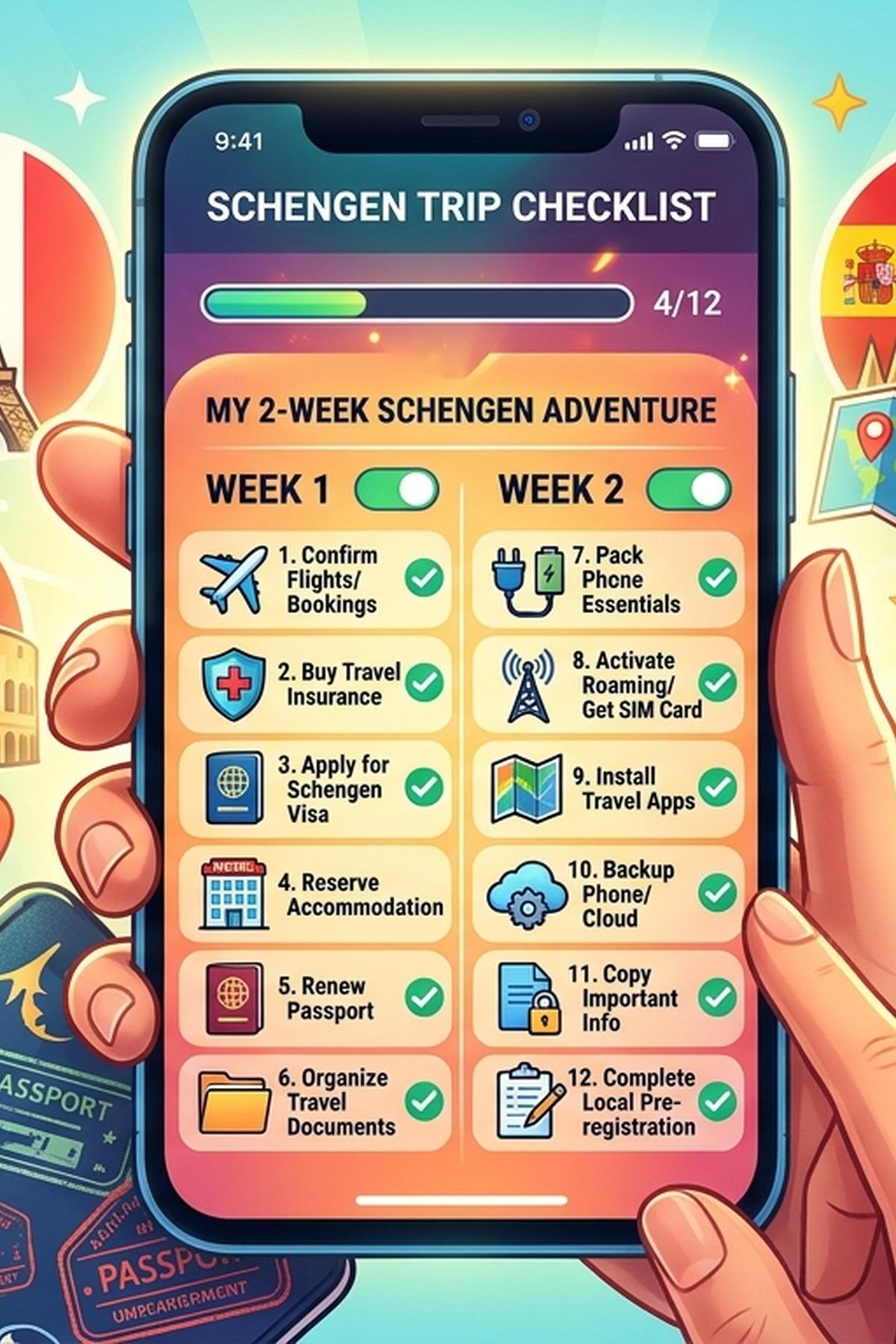
Your train reaches Luxembourg, your hotel sends an entry code, and your phone stops loading messages. That is a poor moment to learn which roaming settings you needed. For a two-week trip through France, Luxembourg, Germany, and Belgium, prepare your connection before departure. Then give your documents and emergency contacts a backup that works without mobile data.
Three Checks Before Departure
- Confirm that your actual mobile plan covers all four countries.
- Save travel documents and arrival directions for offline use.
- Keep emergency contacts accessible if your phone loses service.
Put All Four Countries on Your Phone Plan Check
Use this sample route to make the preparation concrete: days 1 to 4 in France, days 5 to 7 in Luxembourg, days 8 to 11 in Germany, and days 12 to 14 in Belgium. Paris, Luxembourg City, Trier, and Brussels make useful planning bases. This is a suggested allocation, rather than a transport timetable.
Write every country on one note, including transit stops and optional excursions. Check that list against your provider's current destination list. Do not rely on a package name that simply says “Europe.” Keep a dated copy of the terms you actually choose.
Schengen membership does not define roaming coverage. Switzerland is in Schengen but outside EU roaming rules. Liechtenstein is covered through the EEA. A Swiss detour therefore needs a separate tariff check, even if your border paperwork does not change.
For this four-country route, ask one concrete question: “What will my existing SIM charge for data, outgoing calls, incoming calls, and texts in each destination?” Request the answer for your exact plan. A general marketing page may describe a different subscription.
Check Whether EU Roaming Rules Apply to Your SIM
Under EU roaming rules, eligible subscriptions generally use domestic rates during periodic travel within the covered area, subject to fair use. A non-EU home SIM does not gain those rights merely by arriving in France. Tourist SIM eligibility and allowances require checking.
Your nationality and your mobile contract answer different questions. An American visitor using an American subscription should examine that provider's overseas terms. A visa-holder buying a European prepaid SIM should examine the prepaid product's roaming conditions. Neither traveler should infer the answer from their passport.
Make the decision before your departure airport. Compare the total charge for all 14 days, rather than one advertised daily fee. Ask whether a short call, background data session, or voicemail action can trigger a paid roaming day under your contract.
Connection Options for the Same Four-Country Route
| Option | When It Fits | Check Before Choosing |
|---|---|---|
| Existing subscription with covered roaming | You want to keep your usual number and billing. | Eligibility, roaming data allowance, and excluded services. |
| Home provider's travel add-on | Your normal contract has expensive overseas use. | Four-country coverage, charging triggers, and total trip cost. |
| Separate travel SIM or eSIM | You prefer a separate travel data allowance. | Device compatibility, validity, voice service, and destination coverage. |
If you choose to buy eSIM as an alternative to home-network roaming, first verify current coverage for France, Luxembourg, Germany, and Belgium. Check your exact handset model, carrier-lock status, activation instructions, validity period, and whether the selected product includes calls or only data. Do not assume those details from the homepage alone.
Separate Fair-Use Limits From Your Data Budget
Unlimited domestic data can have a roaming allowance. Providers may also assess usage over four months; predominant presence and use abroad can lead to a warning, with 14 days to respond before surcharges. A two-week holiday is different from permanent roaming, but earlier travel can affect that assessment.
Get your allowance in gigabytes, its reset date, and the charge after it runs out. Four borders do not create four fresh allowances.
Build your own spending limit below the provider's ceiling. If your confirmed allowance is 10 GB, for example, set a device warning at 7 GB and review consumption midway through the trip. That is a planning example, not a suggested allowance for every traveler.
Maps and messaging are only part of the picture. Photo uploads, video calls, streaming, and laptop tethering can change your usage sharply. Review the previous week's app consumption before choosing a bundle. Then decide which activities can wait for accommodation Wi-Fi.
- Pause mobile photo backup and automatic app updates.
- Download entertainment before departure instead of streaming on trains.
- Set a data warning below your confirmed roaming allowance.
- Check whether tethering is permitted before connecting a laptop.
- Record the allowance reset date and any travel bundle expiry time.
Prepare Your Settings Before the First Border
If you use two SIMs, label them clearly as “Home” and “Travel.” Select the intended SIM for mobile data. Disable automatic data switching if your device offers it, so a weak travel connection does not silently move data onto your home subscription.
Follow the chosen provider's instructions for data roaming on the travel SIM. Some travel products require it. Keep home-SIM data roaming disabled if that line would incur unwanted charges. Leaving the home line active for verification texts is a separate choice from allowing it to carry mobile data.
Check incoming-call and voicemail costs before keeping that line active. Test access to banking, email, and booking accounts while you still have a reliable connection. Save recovery codes securely where supported. Avoid making every recovery method depend on the same phone.
Check the Network After Each Country Change
Border texts explain roaming prices and fair-use terms. Read them before using data. Terrestrial EU roaming protections do not cover satellite connections aboard ships or aircraft.
For the sample route, make a brief connection check after entering Luxembourg, Germany, and Belgium. Wait until the phone has signal, then send a message or load a small page. Confirm the intended data SIM is still selected. Save any unexpected tariff message for later review.
If service does not return, try airplane mode briefly, then restart the phone. Check the SIM settings and any provider-supplied access point instructions. Use manual network selection only after checking which networks your provider permits. Return to automatic selection later if instructed.
Near a border, inspect the displayed network rather than guessing from your location. This deserves particular attention if you change the itinerary to include a place near Switzerland. A network connection and a passport crossing are separate events.
Build an Offline Folder That Opens Without a Login
A cloud folder is not an offline folder until you test it. Put the phone in airplane mode and open every file you expect to need. A booking email that displays its text but fails to load its attachment is not ready.
Create one clearly named trip folder. Arrange files by travel date, with a separate document section. Keep sensitive copies behind the device's security controls. Your aim is to retrieve a ticket on a platform without searching through months of messages.
- Save passport and visa copies, plus relevant residence documents.
- Download accommodation confirmations and late-arrival instructions.
- Save transport tickets in the format the operator accepts.
- Store insurance details, policy numbers, and assistance contacts.
- Download maps around each station, accommodation, and planned day trip.
- Keep your return itinerary and booking references available offline.
Treat identity-document copies as backups. Carry the required originals. For tickets, follow the issuer's instructions: a screenshot may not replace an app ticket with a changing code. Test the actual ticket before the departure day.
For each arrival, save the accommodation address as plain text and capture the final walking route from the station. Include the entrance instructions. A working map is less useful if the door code remains trapped in an unread message.
Save Emergency Numbers Before You Need Them
Call 112 for an emergency in France, Luxembourg, Germany, or Belgium. Official guidance confirms that emergency calls to 112 are free from fixed and mobile phones throughout the EU. Use the phone's emergency dialler, rather than searching for a messaging app contact.
State your location first: country, town, street, and a nearby landmark. On a train, give the service details and most recent station if you know them. Describe what happened and follow the operator's instructions. Do not depend entirely on automatic location sharing.
Keep other assistance numbers separate. Your insurer's assistance line, accommodation contact, bank card-blocking service, and consular contact have different jobs. Save them with international dialing codes and clear labels. Check current details before departure.
If you need accessible emergency communication, check the arrangements for each destination in advance. Do not assume an emergency text service or app works across all four countries. Never place a test call to 112.
Keep the Phone Useful Through Day Fourteen
Pack a charging cable, a suitable plug adapter, and a power bank appropriate for your journey. Charge before transfer days. Keep one paper note with your next accommodation address and key assistance contacts somewhere separate from the phone.
On day seven, review remaining data, bundle validity, storage space, and the next week's offline files. Refresh maps and tickets over a trusted connection. Confirm that your final airport or station transfer is saved before leaving the last accommodation.
The checklist has worked when you can answer three questions without searching: which SIM carries your data, what happens when its allowance ends, and how you reach your next bed without service. Settle those before departure, then repeat the connection check at each border.
Read next
-
 Flight Delays and Schengen Overstay Risk Under the 90-Day Rule
A flight delay on day 89 or 90 inside Schengen can tip you into overstay. Know your rights, your documentation, and exactly what to do.
-
 SIM Cards, eSIMs, and Roaming Costs for Schengen Multi-Country Travel
Non-EU visitors face real connectivity costs across Schengen. Compare home roaming, local SIMs, and regional eSIM plans before you pack.
-
 Turkey Entry for Schengen Visa Holders and How the Day Count Works
Learn how exiting Schengen for Turkey affects your 90/180-day count, plus ferry crossing options, Turkish visa requirements, and border documentation.
-
 Why the Schengen Agreement Was Signed in a Village of 500 People
The Schengen Agreement was signed in a village of 500 people because it sits at the tripoint where Luxembourg, Germany and France meet, a powerful symbol for border-free travel.