Flight Delays and Schengen Overstay Risk Under the 90-Day Rule
A flight delay on day 89 or 90 inside Schengen can tip you into overstay. Know your rights, your documentation, and exactly what to do.
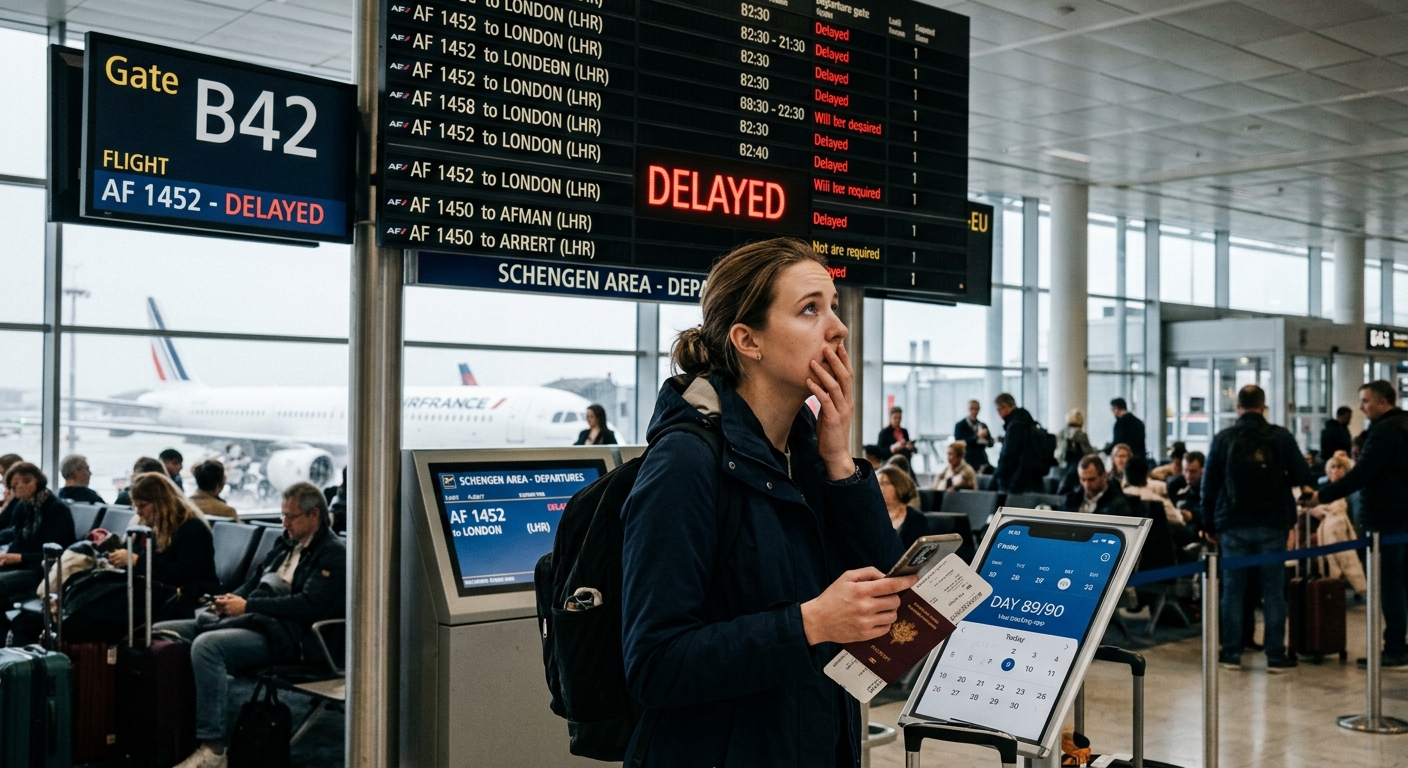
Your Schengen countdown has been running quietly in the background for months. You tracked it carefully, booked your exit flight with time to spare, and arrived at the airport on day 89 feeling like the organized traveler you are. Then the departures board updates. Your flight, the one that was meant to carry you cleanly out of the Schengen Area before midnight, flips to a multi-hour delay. Possibly a cancellation. Your mind races to one question: if I am still physically inside Schengen after day 90, am I now an overstayer?
The answer sits at the intersection of EU border law, air passenger rights, and the judgment calls of individual border officers. This article unpacks exactly where you stand and what you need to do.
Involuntary delay is not the same as deliberate overstay, but it does not grant automatic immunity either.
- Border authorities across Schengen member states have discretion to treat documented, involuntary delays with leniency, but that leniency is not guaranteed anywhere in the Schengen Borders Code.
- EU Regulation 261/2004 gives you rebooking rights and airline care obligations, but it does not extend your legal right to remain inside the Schengen Area by even a single day.
- Your protection relies entirely on a real-time paper trail: airline delay certificates, rebooking confirmations, and timestamped communications collected on the day itself.
How the 90/180-Day Rule Counts Your Presence
The rule is deceptively simple on paper. You may spend a maximum of 90 days inside the Schengen Area within any rolling 180-day period. The calculation looks backward from any given date, counts every day you were physically present inside Schengen during the previous 180 days, and produces a running total. Your entry date counts. Your exit date counts too.
What the rule does not do is account for why you are still there on a given day. The Schengen Borders Code treats the 90-day ceiling as an objective limit tied to physical presence. There is no provision that automatically suspends the count for force majeure events like flight cancellations or technical faults. That gap is exactly what creates legal grey territory for delayed travelers.
Border officers at exit points do have discretion. The code acknowledges that exceptional circumstances can justify a short overstay without immediate sanction, but that acknowledgment is general and does not enumerate specific qualifying events. A flight cancellation may well qualify. Whether it does in practice depends on your documentation and the officer you encounter.
The Legal Grey Zone You Enter on Day 91
Imagine you check in online on the evening of day 89. Your flight is scheduled for 6 a.m. on day 90. The airline cancels it at 2 a.m. due to a technical fault. The next available seat on any flight out of Schengen is 36 hours away. You are now facing day 91 inside Schengen territory through no fault of your own.
Your exposure in this scenario is real but manageable. No EU law explicitly criminalizes an overstay caused by a flight cancellation, and the European Commission has historically expected member states to apply the force majeure principle in documented cases. That principle recognizes that a person who cannot leave through circumstances entirely outside their control should not be treated as a deliberate violator. The key word is documented. Without evidence of the cancellation, the rebooking attempts, and your effort to exit at the earliest possible opportunity, you have no practical defense at the border.
It is worth understanding that Schengen border stamps do not record the reason for a stay, only its duration. If your passport shows an entry on day one and an exit stamp on day 92, a future border officer reviewing your travel history will see an apparent two-day overstay. Your documentation needs to be robust enough to explain that gap clearly, even years later.
What EU Passenger Rights Give You and What They Do Not
EU Regulation 261/2004 is the framework most travelers have heard of for flight delays and cancellations. Under this regulation, if your flight is cancelled and the airline bears responsibility, you are entitled to a choice: a full refund or re-routing to your final destination at the earliest available opportunity. The airline must also provide meals, refreshments, and hotel accommodation where an overnight wait is required.
These are meaningful protections. They ensure the airline bears the cost of the disruption rather than passing it to you. Air passenger compensation rules set out exactly which delay lengths and cancellation scenarios trigger which entitlements, and the thresholds vary by flight distance.
What Regulation 261/2004 cannot do is extend your immigration authorization. It operates purely within the civil aviation and consumer rights space. The moment your 90th day inside Schengen passes, border law takes over from passenger rights law. The two frameworks exist side by side but do not interact. Your rebooking confirmation from the airline is critical, not because it grants you more time in Schengen, but because it is evidence that you pursued exit at the first available opportunity. That is the narrative you must present to a border officer.
Why Monitoring Your Outbound Flight from 24 Hours Out Changes Everything
The best time to act is before a delay becomes a crisis. Starting at least 24 hours before your scheduled departure, check your flight status directly and frequently. Airline apps update in real time, but they do not always explain what a given status actually means for your immediate options.
Knowing how to interpret flight status codes properly changes your decision-making speed. A flight showing as "delayed" with a one-hour push tells you something very different from one flagged as "cancelled" or "diverted." The difference between waiting at the gate and immediately approaching the airline desk to rebook can be the difference between catching a same-day alternative and spending an unplanned night inside Schengen. Status categories that indicate ground stops, equipment changes, or crew-related holds tend to resolve far more slowly than localized weather delays at your specific airport. Acting on that distinction early gives you more rebooking options before seats fill up on alternative routes.
If you are in the day 89 to day 90 window, treat any status worse than confirmed "on time" as a reason to act rather than wait. Contact the airline directly, go to the desk in person, and ask explicitly about the earliest available rebooking. Get everything in writing or captured as a screenshot with a visible timestamp.
The Documentation That Preserves Your Compliance Record
If a delay or cancellation does push you past day 90, your protection rests entirely on the paper trail you build in real time. This is not something you can reconstruct after the fact. Border officers are experienced at identifying whether documentation was genuinely collected on the day or assembled later.
The record you want to assemble includes the original airline notification of the delay or cancellation, with a visible timestamp on the email, SMS, or push notification. You also need the official airline delay or cancellation certificate, your new boarding pass or rebooking confirmation showing the earliest available flight, and any hotel booking or meal voucher issued by the airline under Regulation 261/2004. Collectively, these documents tell a single coherent story: you intended to leave, the airline prevented it, and you booked the first available way out.
Keep everything in both digital and printed form where possible. Border officers at smaller Schengen exit points sometimes work with limited connectivity. A printed copy of your rebooking confirmation is harder to dismiss than a phone that loses battery or signal at precisely the wrong moment.
If Your Flight Cancels on Day 89 or 90, Work Through This in Order
Time matters here. These steps need to happen fast and in sequence, not after a long wait at baggage reclaim or a prolonged debate at the gate.
- Approach the airline desk immediately. Skip the general queue if there is a dedicated cancellations or disruptions counter. Ask for the earliest available rebooking to your destination or any hub outside the Schengen Area, and request a written cancellation or delay certificate before you leave the desk. Do not accept a verbal confirmation.
- Screenshot every notification with timestamps visible. Capture the airline alert, the departures board, and the updated status on the airline app. These contemporaneous records can be cross-checked by a border officer and carry far more weight than anything you describe verbally from memory.
- Contact the nearest Schengen border authority proactively. You are not legally required to do this, but proactively informing them signals good faith. In France, that is the Police aux Frontières. In Germany, the Bundespolizei. In the Netherlands, the Koninklijke Marechaussee. A brief email or phone call explaining your situation, with your documentation attached, creates a formal record of your intent to comply and your effort to exit as early as possible.
- Request a written letter from the airline stating the specific reason for the cancellation. Mechanical fault, crew limitations, and operational issues are airline-attributable causes. This distinction strengthens your force majeure argument at the border. Weather-related delays are less straightforward because they may be viewed as partly foreseeable depending on the conditions and advance warning available.
- Take the first available flight out of Schengen, even if the timing is inconvenient. Opting for a more comfortable departure four hours later when an earlier seat was available undercuts the argument that you left at the earliest opportunity. Border officers look at the timeline of your rebooking relative to what was actually on offer at the time of cancellation.
- At exit border control, present your documentation before the officer asks for it. State clearly that your original flight was cancelled, hand over the paperwork, and confirm the date and time of the cancellation. Proactive disclosure is consistently received better than information offered only after direct questioning.
After You Exit: What Your Schengen Record Shows and How to Protect It
Once you clear the exit checkpoint, your immediate legal exposure closes. Keep all documentation for at least six months after the trip. Some travelers have encountered questions at their next Schengen entry when an overstay flag appeared in border records, even for a well-documented, involuntary delay. Flags of this kind are not always automatically resolved on the system side, even when the border officer at the time waved you through without issue.
If your passport shows entry and exit dates that exceed 90 days, write a brief factual summary of the incident and carry it with your travel documents going forward. It does not need to be a formal letter. It simply needs to match the dates on your airline paperwork. A border officer reviewing your stamps on a future trip will appreciate having that context rather than asking you to reconstruct a stressful airport night from memory, under pressure, at a border queue.
The 90-day rule was designed to limit intentional long-term stays, not to penalize travelers grounded by a hydraulic fault at midnight. The law acknowledges that reality, even if imprecisely. The force majeure principle exists precisely for situations like this. Your job is to make sure the evidence proves, clearly and without doubt, which category you belong to. Collect it on the day, keep it organized, and you will have a credible case at every border you cross afterward.
Read next
-
 SIM Cards, eSIMs, and Roaming Costs for Schengen Multi-Country Travel
Non-EU visitors face real connectivity costs across Schengen. Compare home roaming, local SIMs, and regional eSIM plans before you pack.
-
 Turkey Entry for Schengen Visa Holders and How the Day Count Works
Learn how exiting Schengen for Turkey affects your 90/180-day count, plus ferry crossing options, Turkish visa requirements, and border documentation.
-
 Why the Schengen Agreement Was Signed in a Village of 500 People
The Schengen Agreement was signed in a village of 500 people because it sits at the tripoint where Luxembourg, Germany and France meet, a powerful symbol for border-free travel.
-
 Luxembourg Moselle Wine Route Riesling Crémant and Village Cellars
The Luxembourg Moselle wine route runs through Schengen, where Riesling, Pinot Gris and Crémant de Luxembourg are poured in village cellars with river views.