SIM Cards, eSIMs, and Roaming Costs for Schengen Multi-Country Travel
Non-EU visitors face real connectivity costs across Schengen. Compare home roaming, local SIMs, and regional eSIM plans before you pack.
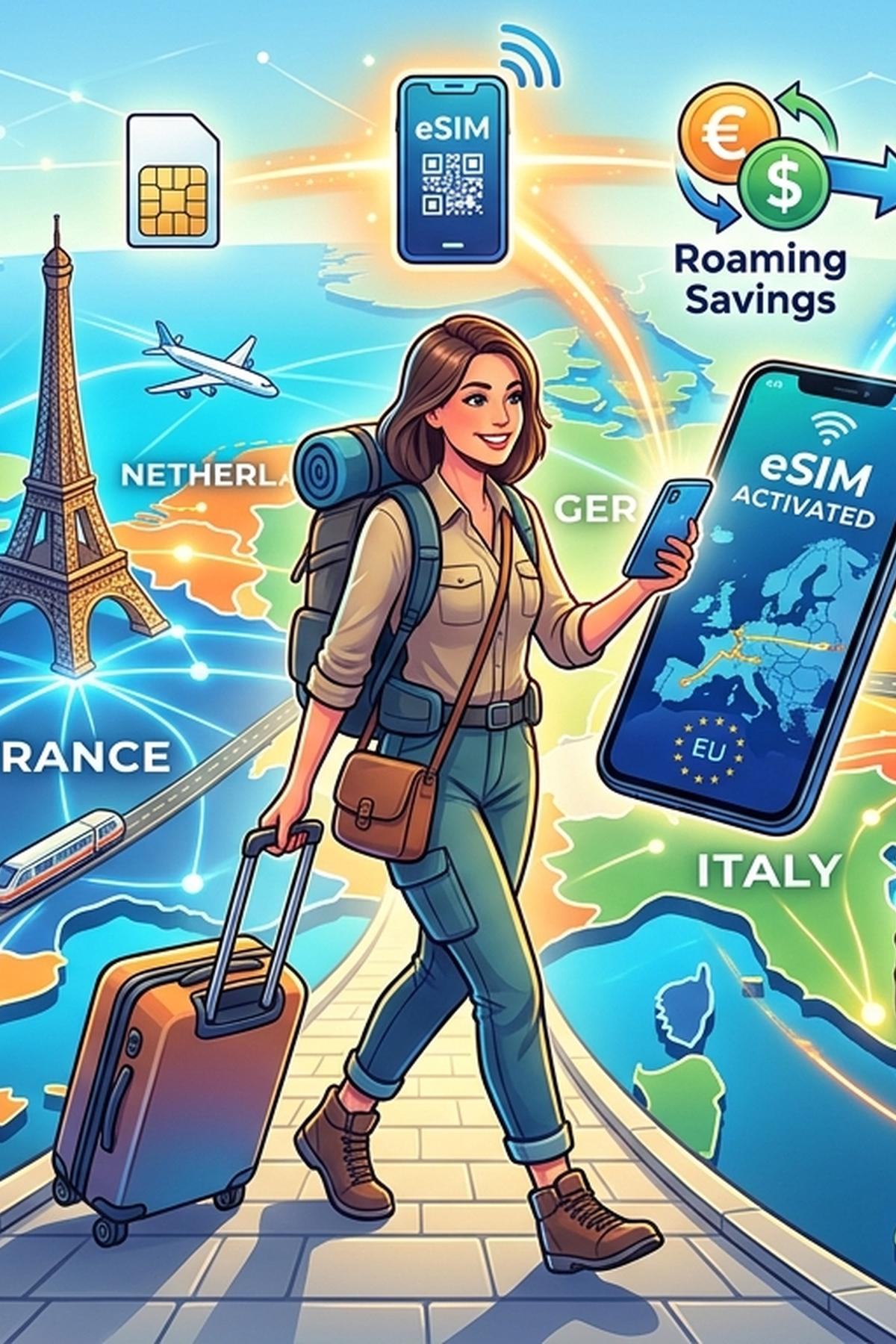
Your phone works in Schengen. That part is not the problem. The problem is what you will pay for that privilege. Non-EU visitors step into a connectivity gap that European residents never have to think about. Since 2017, people with a mobile subscription in an EU or EEA country have been able to use their home plan across all member states at no extra charge. That protection was built for residents, not tourists. If your SIM is from the US, Canada, Australia, or anywhere outside the European Economic Area, you pay what your home carrier decides to charge. Sometimes that figure is manageable. Often it is not.
Non-EU visitors pay full international rates across every Schengen country unless they make a deliberate connectivity choice before they land.
- Home-carrier day passes can cost $10 or more per line per day on most major US and Canadian networks.
- Per-country local SIMs cut costs sharply for single-destination trips but multiply the friction for multi-country routes.
- A regional eSIM covering all Schengen member states eliminates the SIM-swap problem with one purchase and one shared data pool.
Why the EU's Roaming Rules Don't Protect Visitors
The EU's "Roam Like at Home" regulation came into force on 15 June 2017. Under it, a French resident using their French plan in Portugal pays nothing extra. A German subscriber in the Netherlands is charged the same rates as at home. The European Commission's published EU roaming rules confirm that this protection applies to people who hold a mobile subscription in an EU or EEA member state and who are temporarily visiting another member state. The regulation was designed to stop Europeans from being penalised for crossing borders within the bloc. It was never intended to cover every visitor who lands at a Schengen airport.
A traveler arriving from outside the EEA carries a SIM issued by a carrier with no obligation under European roaming law. What you pay is set entirely by your home operator's international pricing, which varies considerably between carriers and between plan tiers.
What Home Carrier Roaming Actually Costs You
Major US and Canadian carriers have built travel add-ons that make international roaming almost automatic. Automatic is not the same as affordable.
- AT&T International Day Pass ($10/day per line): Activates on the first day you use data or make a call abroad. You keep your home-plan speeds and data allocation for that 24-hour window.
- Verizon TravelPass ($10/day per line): Works on the same automatic-activation model. Only charges on days you actually use your phone in a covered country.
- T-Mobile Go5G and above (included with caveats): Some plans include Schengen countries with up to 5GB of high-speed data per billing cycle, then throttle to 128 kbps. If you stream maps, use video calls, or rely on cloud backup, throttled speeds become a genuine obstacle within days.
- Rogers and Bell Canada ($12 to $15 CAD/day): Roam Like Home add-ons give you the same plan as at home for a 24-hour window, automatically activated on first use.
The per-day model is tolerable for a weekend trip. For two weeks in Europe, it compounds fast. A solo traveler on AT&T who roams for 14 days pays $140 in international fees on top of their regular monthly bill. A couple traveling together pays $280. A family of four on the same plan pays $560 for connectivity alone during a two-week Schengen trip.
Per-Country Local SIMs: Strong Value with a Hard Limit
Prepaid SIMs at your destination remain one of the best values in travel connectivity, provided you are staying in one country. France has prepaid options from Orange, Free, and SFR that run roughly 10 to 15 EUR for 20GB or more, valid for 30 days. Germany offers Aldi Talk and REWE Mobile at comparable prices. Italy, Spain, and the Netherlands all have airport and supermarket SIMs in the same price range.
For a three-week stay in a single destination, that math is decisive. A French SIM at 12 EUR beats 21 days of $10-per-day roaming by a wide margin. The complication arrives the moment your itinerary crosses a border.
Most tourist-targeted prepaid SIMs sold in one Schengen country do not offer useful data roaming in other Schengen countries. A SIM bought at a Paris tabac may go dark or fall back to a tiny daily data cap once you cross into Belgium or Germany. Some carrier SIMs do include EU roaming at the resident rate, but tourist-tier prepaid cards are frequently excluded or limited to a few hundred megabytes per day at steep foreign rates.
Carrying two or three SIMs across a multi-country route also means managing different numbers, different top-up systems in different languages, and the risk of running dry in a country where you cannot easily buy more credit. These are solvable problems. They are also problems you have to solve repeatedly, at every border.
How a Schengen-Wide eSIM Removes the Swap Problem
An eSIM is a software-based SIM profile stored in your phone's embedded chip. You purchase a plan, receive a QR code, and download the carrier profile before you leave home. No physical card. No kiosk search at the arrivals hall. No foreign-language top-up page to decipher at midnight.
The specific value for multi-country Schengen travel is uniform coverage. A Schengen eSIM plan pools your data allowance across all member states under a single package. Cross from France into Switzerland, then down into Austria, and your data balance stays the same. Your number does not change. Nothing needs reconfiguring at any border.
What these regional plans typically include:
- Data packages from 3GB to 20GB covering all 27 Schengen member states, with validity windows of 7 to 30 days
- One-time pricing with no daily activation fees, no surprise charges for crossing into a new country
- Setup by QR code in minutes, on any unlocked phone with eSIM hardware support
Pricing for Schengen-wide eSIM plans generally runs from about $15 to $35 USD depending on data volume and trip length. A 10GB plan at roughly $20 for 30 days costs less than two days of AT&T day-pass charges. The break-even point against home-carrier roaming arrives quickly, usually within three to four days of active use.
The one gap in most data-only eSIM plans is voice calls. These plans provide a data connection, not a local phone number. For personal calls, that is rarely a problem since most travelers use WhatsApp, Signal, or FaceTime Audio over data without issue. If your itinerary requires local calls for hotel check-ins or transport reservations, pair the eSIM with a cheap voice SIM from your first country of entry and use your phone's dual-SIM capability to handle both.
Matching Your Connectivity Plan to Your Itinerary
There is no single right answer for every traveler. The best choice depends on how many countries you are crossing, how many days you are staying, and how much data you actually use. Work through these scenarios in order:
- One country, under five days: Use a home-carrier day pass. The daily fee is high relative to what you receive, but the absolute cost for a short stay stays modest and the setup requires zero effort.
- One country, one to three weeks: Buy a local SIM on arrival. Airport and supermarket options will almost always undercut your home carrier by a significant margin. Look for prepaid cards at the arrivals hall or a supermarket near your first accommodation.
- Two to three countries, any trip length: Evaluate a regional eSIM seriously. The SIM-swap hassle and coverage gaps from local SIMs begin to cost you more time and money than the eSIM price difference.
- Four or more countries, any trip length: A regional eSIM is the practical default. One plan, one data pool, no decisions at any border crossing.
- Group travel: Multiply every cost above by headcount. Day-pass roaming scales linearly with people. A family of four on US carriers for two weeks in Schengen can hit four figures in roaming fees before accounting for the regular monthly bill.
Before you buy anything, verify two things: that your phone supports eSIM, and that your device is unlocked from your home carrier. Phones released after 2018 generally support eSIM hardware, but carrier locks vary by plan and by market. A quick call to your carrier before departure clears both questions.
Your Itinerary, Your Budget, Your Call
There is a simple calculation worth running before you pack. Open your carrier's international roaming page. Map out every day of your Schengen trip and total the roaming cost under your current plan. Write that number down. Then price a regional eSIM for the same trip length and country count. The gap between those two numbers is what better planning is worth to you in this specific context.
For a solo traveler doing a week across three countries, the savings might land between $40 and $60. For a couple doing two weeks across five countries on a US day-pass plan, the gap can easily exceed $200. For a family, it crosses into territory where the connectivity choice materially affects the overall trip budget.
The EU's internal roaming market has made European residents largely indifferent to which country they happen to be in. Non-EU visitors do not get that indifference. Staying connected across Schengen requires a deliberate choice, and that choice carries a real price. Running the numbers once, before you leave home, is the only way to make sure that price is the one you actually chose to pay.
Read next
-
 Turkey Entry for Schengen Visa Holders and How the Day Count Works
Learn how exiting Schengen for Turkey affects your 90/180-day count, plus ferry crossing options, Turkish visa requirements, and border documentation.
Turkey Entry for Schengen Visa Holders and How the Day Count Works
Learn how exiting Schengen for Turkey affects your 90/180-day count, plus ferry crossing options, Turkish visa requirements, and border documentation.
-
 Why the Schengen Agreement Was Signed in a Village of 500 People
The Schengen Agreement was signed in a village of 500 people because it sits at the tripoint where Luxembourg, Germany and France meet, a powerful symbol for border-free travel.
Why the Schengen Agreement Was Signed in a Village of 500 People
The Schengen Agreement was signed in a village of 500 people because it sits at the tripoint where Luxembourg, Germany and France meet, a powerful symbol for border-free travel.
-
 Luxembourg Moselle Wine Route Riesling Crémant and Village Cellars
The Luxembourg Moselle wine route runs through Schengen, where Riesling, Pinot Gris and Crémant de Luxembourg are poured in village cellars with river views.
Luxembourg Moselle Wine Route Riesling Crémant and Village Cellars
The Luxembourg Moselle wine route runs through Schengen, where Riesling, Pinot Gris and Crémant de Luxembourg are poured in village cellars with river views.