The SNCF Rail Booking Maze and the Reality of Grèves
French train travel means navigating TGV and TER bookings, validating paper tickets, and surviving strikes. Here's the full system.
The SNCF Rail Booking Maze and the Reality of Grèves
You need to get from Paris to Nice and you have just opened the SNCF website. It offers TGV InOui, Ouigo, and Intercités, each with different booking windows, cancellation rules, and price structures. Book TGV InOui for speed and flexibility. Book Ouigo for the lowest cost, but accept strict baggage limits. Use TER for regional hops where you want to show up and board without a reservation.
The French railway system does not reward last-minute decisions. TGV InOui and Intercités open bookings exactly 4 months ahead. Ouigo opens 6 to 9 months ahead. TER windows vary by region, usually 3 to 4 months. If you are travelling in July and wait until June to book a TGV from Paris to Marseille, you will pay peak yield management prices or find sold-out trains. Book the moment your dates are locked.
The single mistake that costs tourists money and time is the validation step. Stamp paper tickets in the yellow compostage machines on the platform before boarding. No stamp means an on-the-spot fine. Digital tickets on the SNCF app do not need composting, but the app requires a working phone and a signal. If your battery dies at a rural station with no staff, you cannot board. Print your ticket and compost it, or keep your phone charged and the app open before the platform gate.
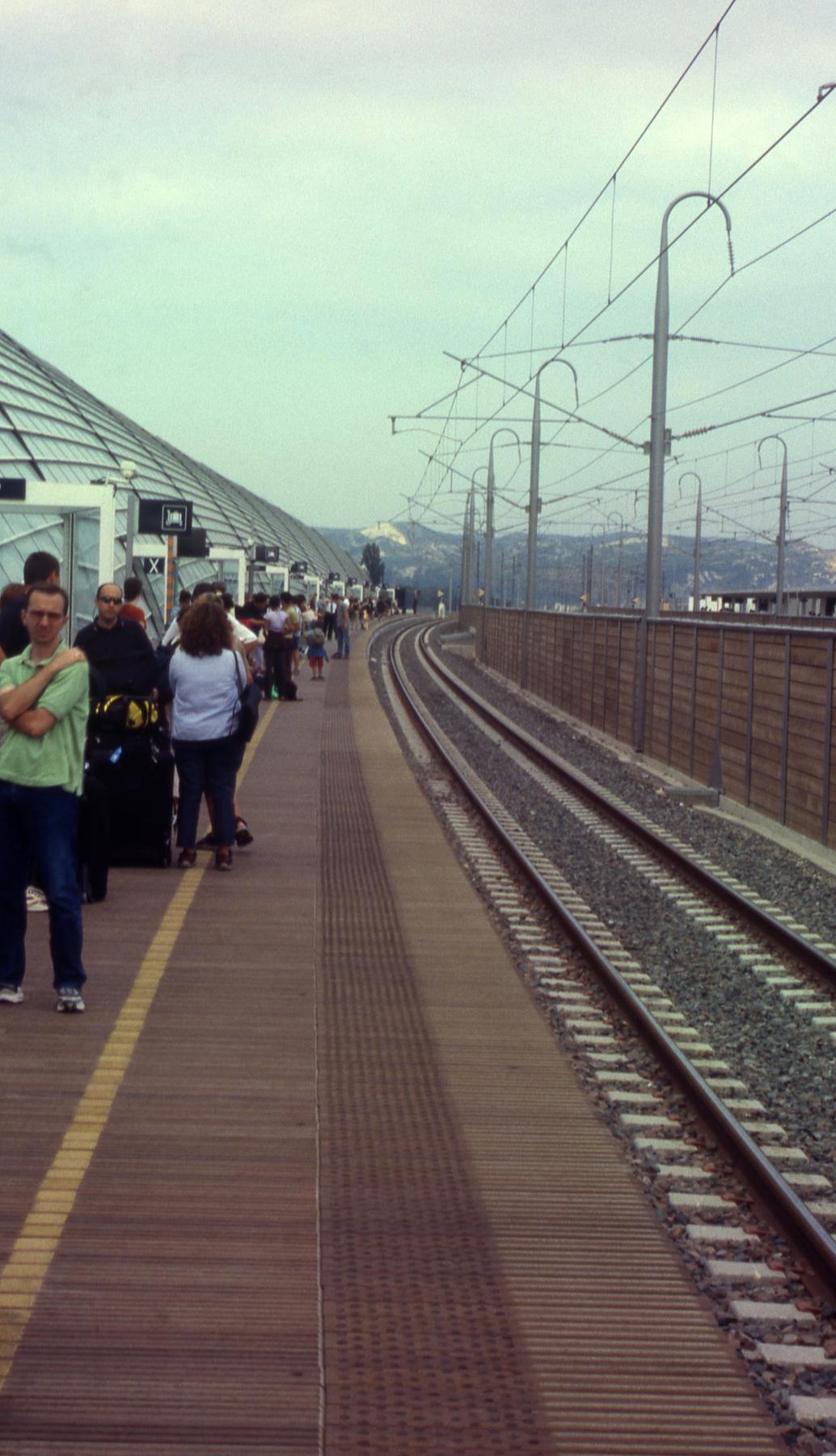

Which Train Service for Which Trip
TGV InOui
SNCF's flagship high-speed service. Mandatory reservation. Two classes, first and second. A café-bar onboard. Fares are yield managed so the same Paris to Lyon seat can cost €25 booked 4 months out or €90 booked 3 days out. Make this your default for any city pair over roughly 200km.Ouigo
The low-cost high-speed alternative. Single class only. Extra fees for cabin luggage, for a power socket, for seat selection. Trains run on the same TGV tracks but stop at peripheral stations. Paris to Marseille on Ouigo departs from Marne-la-Vallée, not Gare de Lyon. Factor in transport time to the Ouigo station. Baggage allowance is strict: one small cabin bag free, everything else costs. If your suitcase is large, the fee can erase the fare saving.TER
Regional trains with no reservation and fixed prices. Buy a ticket at the machine or on the app, board any train on that route that day. TER covers the gaps TGV skips: Colmar to Strasbourg, Saint-Émilion to Bordeaux, the coastal line from Cannes to Ventimiglia. Rural stations often have no staffed counter and card readers that reject non-chip cards. Carry cash and a chip-and-PIN card.Intercités
Classic long-distance trains, slower than TGV, cheaper on some routes. Reservation is mandatory on some routes, optional on others. Check the listing for "réservation obligatoire". Intercités de Nuit sleeper trains exist on Paris to Briançon and Paris to Rodez lines. Book those mandatory-reservation routes at least 2 months ahead in summer.What a Strike Actually Does to Your Trip
A grève is announced with a legal minimum of 48 hours notice. The SNCF publishes the actual service plan on its website and app by 17:00 the day before the strike. Typical service on a strike day: 30 to 70 percent of normal TGV service, 20 to 50 percent of TER, and some lines suspended entirely. Ouigo and TER are hit harder than TGV InOui because regional staff strike at higher rates.
If your train is cancelled, you get a full refund or a free exchange to another train on the same route. Claim online or at a staffed counter. If your train is running but delayed by a strike, the standard SNCF delay compensation applies: 25 percent of the fare for 30 to 59 minutes delay, 50 percent from 60 minutes up. File the claim within 60 days on the SNCF website. The refund lands as a voucher unless you request a bank transfer.
Your Move When a Strike Hits
The 24 hour cancellation reality is this: if a strike is announced at 48 hours, cancel your ticket for full refund right then. SNCF waives change fees during strike periods. If you wait until the morning of travel and your train is still running, you lose that right. The decision framework is simple. If your train is cancelled, take the refund and look at FlixBus or BlaBlaCar Bus. Paris to Lyon by bus costs €10 to €25 and takes 5.5 to 7 hours. Paris to Bordeaux costs the same and takes 7 to 8.5 hours. If your train is running but you need to be somewhere by a firm time, rebook an earlier train on the same route to absorb delays. If you have flexibility, wait: many strikes last one day and normal service resumes the next morning. If your train is cancelled and you need an alternate route east, Luxembourg’s free public transport makes it a low-cost staging point once you cross the border.When the Train is Not Your Best Option
The Paris to Lyon domestic flight was banned. The routes from Paris Orly to Bordeaux, Nantes, and Lyon are all banned where a rail alternative under 2 hours 30 minutes exists. For longer routes, the flight still runs. But the train is faster than flying for almost every corridor under 4 hours when you factor in airport transfer and security.
Driving and Low-Emission Zones
Driving is an alternative but carries its own friction. Motorway tolls on the Paris to Lyon run cost roughly €35 for a standard car. Fuel runs €1.70 to €1.90 per litre for diesel, €1.80 to €2.00 for SP95-E10. Every car entering a low-emission zone in Paris, Lyon, Grenoble, Strasbourg, Rouen, Reims, Saint-Étienne, Montpellier, Toulouse, Nice, Toulon, or Aix-Marseille needs a Crit'Air sticker. It costs €4.76 and lasts the lifetime of the vehicle but you must order it before you drive. No sticker means a fine if checked.Bus as a Strike Backup
Long-distance buses work as a strike backup. FlixBus and BlaBlaCar Bus run Paris to Lyon from €10 and Paris to Bordeaux from €10. Journey times are 5.5 to 8.5 hours depending on traffic. Buses do not strike as often as SNCF. If a strike cancels your TGV at 17:00 the day before, check the bus operator immediately because their seats sell out too.If it is 1am and nothing runs, your options are a taxi or waiting until the first TER at 5am. Rural stations close overnight. Do not plan a 1am arrival by train unless you have a car or a prebooked taxi waiting. Stations in small towns do not have 24 hour waiting rooms.
Rail Passes and the Break-Even Math
The Interrail France Pass starts at €174 for 3 travel days in 1 month, second class, adult. The Eurail France Pass starts at €194 for the same terms. Neither pass covers reservation fees, which on TGV InOui run €10 to €20 per train in second class and €20 to €40 in first. A pass breaks even at 2 to 3 long-distance TGV or Intercités journeys. If your trip is Paris to Avignon, Avignon to Marseille, Marseille to Nice, that is three TGV legs. The pass saves money. If your trip is Paris to Lyon and back, two TGVs, a pass and two separate advance tickets cost about the same. Book the separate tickets early for maximum discount.
TER has no reservation fees. The pass covers unlimited TER travel on your active days. If you are doing a multi-stop tour of Provence or Alsace by TER, the pass becomes very efficient because you hop trains without buying tickets at each station.
Common Questions
Can I buy a TGV ticket at the station on the day of travel?
Yes, but the price will be the highest yield management tier. Book online at least 2 weeks ahead for the best fare. Rural stations often have no staffed counter so bring a chip-and-PIN card for the machine.
What happens if my train is cancelled due to a strike?
You get a full refund or a free exchange to another train on the same route. File the claim on the SNCF website within 60 days. For delays of 30 to 59 minutes you get 25 percent of the fare back, for delays over 60 minutes you get 50 percent.
Do I need to validate a digital ticket on my phone?
No. Only paper tickets need stamping in the yellow compostage machine on the platform before boarding. Digital tickets in the SNCF app are valid as shown. Keep your phone charged because you will need the QR code to pass the platform gate.
Is the Ouigo luggage policy really that strict?
Yes. One small cabin bag free. A carry-on size bag costs a fee. A large suitcase costs a higher fee. Checked baggage costs even more. If you book Ouigo, bring only a backpack that fits under the seat. The fees can add €20 to €40 to a €10 ticket.
Read next
-
 Which Paris Airport to Choose and When to Fly Into a French Region Instead
How to decide between Paris CDG, Orly, or a regional French airport based on your itinerary, train connections, and total door-to-door time.
Which Paris Airport to Choose and When to Fly Into a French Region Instead
How to decide between Paris CDG, Orly, or a regional French airport based on your itinerary, train connections, and total door-to-door time.
-
 Best Time to Visit France and Why August Is the Real Trap
August looks perfect on paper but France's domestic holiday exodus closes city shops and overloads the coast. Here's when to go instead.
Best Time to Visit France and Why August Is the Real Trap
August looks perfect on paper but France's domestic holiday exodus closes city shops and overloads the coast. Here's when to go instead.
-
 Tipping in France and Why Most Online Advice Gets It Wrong
Service is included on French restaurant bills, and most tipping advice online is wrong. Here's what locals actually expect, plus card rules.
Tipping in France and Why Most Online Advice Gets It Wrong
Service is included on French restaurant bills, and most tipping advice online is wrong. Here's what locals actually expect, plus card rules.
-
 France Safety Guide Where Pickpocketing Is the Real and Concentrated Risk
Violent crime against tourists in France is rare, but pickpocketing is concentrated on the CDG RER B, Louvre queues, and Gare du Nord.
France Safety Guide Where Pickpocketing Is the Real and Concentrated Risk
Violent crime against tourists in France is rare, but pickpocketing is concentrated on the CDG RER B, Louvre queues, and Gare du Nord.
-
 What a Day in France Costs and the Lunch Menu Trick That Halves It
A realistic daily budget for France, plus the fixed-price lunch menu strategy that cuts food costs in half while letting you eat better.
What a Day in France Costs and the Lunch Menu Trick That Halves It
A realistic daily budget for France, plus the fixed-price lunch menu strategy that cuts food costs in half while letting you eat better.
-
 French Public Holidays and the May Bridge Habit You Need to Know
French public holidays trigger the bridge habit of taking extra days off. May is the worst for closures and crowded trains. Plan around it.
French Public Holidays and the May Bridge Habit You Need to Know
French public holidays trigger the bridge habit of taking extra days off. May is the worst for closures and crowded trains. Plan around it.
-
 SIM Cards, eSIMs, and Roaming Costs for Schengen Multi-Country Travel
Non-EU visitors face real connectivity costs across Schengen. Compare home roaming, local SIMs, and regional eSIM plans before you pack.
SIM Cards, eSIMs, and Roaming Costs for Schengen Multi-Country Travel
Non-EU visitors face real connectivity costs across Schengen. Compare home roaming, local SIMs, and regional eSIM plans before you pack.
-
 Turkey Entry for Schengen Visa Holders and How the Day Count Works
Learn how exiting Schengen for Turkey affects your 90/180-day count, plus ferry crossing options, Turkish visa requirements, and border documentation.
Turkey Entry for Schengen Visa Holders and How the Day Count Works
Learn how exiting Schengen for Turkey affects your 90/180-day count, plus ferry crossing options, Turkish visa requirements, and border documentation.
-
 Why the Schengen Agreement Was Signed in a Village of 500 People
The Schengen Agreement was signed in a village of 500 people because it sits at the tripoint where Luxembourg, Germany and France meet, a powerful symbol for border-free travel.
Why the Schengen Agreement Was Signed in a Village of 500 People
The Schengen Agreement was signed in a village of 500 people because it sits at the tripoint where Luxembourg, Germany and France meet, a powerful symbol for border-free travel.