Dual Nationals and the Schengen Entry Rules Nobody Explains Clearly
A practical guide to Dual Nationals and the Schengen Entry Rules Nobody Explains Clearly.

The passport choice that changes everything
Dual nationals often assume their two passports are interchangeable at a Schengen border. They are not. The document you hand to the border officer determines whether you are processed as a European citizen with full free-movement rights or as a third-country national subject to time limits, biometric registration, and future travel authorisations. The rules are straightforward once you see them laid out, yet official guidance is scattered across multiple agencies and rarely presented in one place. the guidance pulls together the verified requirements so you can make an informed choice every time you travel.
Which passport exempts you from the rules
If you hold citizenship of an EU Member State, Iceland, Liechtenstein, Norway, or Switzerland, that passport or national identity card is your key to the most favourable entry conditions. Present it at the external Schengen border and you are exempt from ETIAS, the 90/180-day short-stay limit, Entry/Exit System biometric registration, and passport stamping. These exemptions apply regardless of any other nationality you hold.
The official ETIAS website states the requirement plainly: a dual national who also holds a passport from a European country requiring ETIAS "must travel with the passport issued by the European country requiring ETIAS" and is exempt from ETIAS on that basis. The same principle extends to EU/EEA/CH citizens more broadly. Your European passport is not merely a travel document; it is the instrument that activates your free-movement rights under Directive 2004/38/EC, which entitles you to enter another Member State with only a valid identity card or passport and prohibits Member States from imposing additional formalities.
What happens when you use the other passport
Choosing to enter the Schengen area on a non-EU passport carries immediate consequences. You are treated as a third-country national for the duration of that stay. The 90/180-day short-stay limit applies, meaning you may not remain in the Schengen area for more than 90 days in any rolling 180-day period. You are registered in the Entry/Exit System, which has been fully operational at all external Schengen border crossing points since 10 April 2026. Your fingerprints and facial image are collected, and your entry and exit dates are recorded digitally. Once ETIAS launches, you may also need a valid travel authorisation or a visa, depending on your non-EU nationality.
This is not a theoretical risk. The European Commission confirms that a dual EU/non-EU national who presents a non-EU passport "is treated as a third-country national" with all the attendant restrictions. The system does not cross-reference your other nationalities automatically. The passport you present is the identity the border guard processes.
The booking and check-in puzzle
Airlines care about two things: that the passenger details match the booking, and that the passenger has the right to enter the destination country and depart the origin country. Dual nationals can satisfy both requirements by using the passport that matches the booking at airline check-in while showing the second passport to prove departure rights if needed. This practice is recognised by the IATA Control Authorities Working Group, which advises that passengers holding multiple passports may need to present the document matching the reservation but can also show the second passport to demonstrate compliance with exit requirements.
Our recommendation: book your flight using the passport details of the document you intend to present at the destination border. If you plan to enter Schengen as an EU citizen, use your EU passport for the booking. Carry both passports with you at all times during travel. At check-in, present the passport matching the booking first, then offer the second passport if the agent needs to verify your right to depart the origin country. This approach minimises confusion and keeps your entry strategy intact.
Which lane to use at the border
The Schengen Borders Code permits Member States to establish separate lanes by passenger category. EU/EEA/CH citizens are entitled to use lanes designated for EU passport holders. Dual nationals travelling on a non-EU passport must generally use the "all passports" lanes, unless they are travelling with an EU family member or the border officer exercises discretion to allow them into the EU lane.
The practical implication is clear: if you want faster processing through the EU lane, present your EU passport. If you present a non-EU passport, expect to queue with other third-country nationals. The lane you use is a direct consequence of the passport you choose to show.
Countries inside and outside Schengen
The Schengen area comprises 29 countries: 25 EU Member States plus Iceland, Liechtenstein, Norway, and Switzerland. All EU countries participate except Ireland and Cyprus. Bulgaria and Romania became full Schengen members on 1 January 2025, following the lifting of air and sea border controls on 31 March 2024 and land border controls on 1 January 2025. When you enter any of these 29 countries, you are entering the Schengen area, and the same rules on passport choice apply uniformly at all external borders.
Ireland is not part of Schengen and operates its own entry rules. Cyprus has not yet had internal border controls lifted and is not yet a full Schengen participant. If your travel includes these countries, verify their specific entry requirements separately.
Family members and the EES exemption
Non-EU family members of EU citizens who hold a valid residence card issued under Article 10 or Article 20 of Directive 2004/38/EC are exempt from EES registration. This exemption applies whether they are travelling with or without the EU citizen family member. If you are a dual national travelling with a non-EU spouse or child who holds such a residence card, that family member will not be fingerprinted or photographed under EES, regardless of which passport you present. This is a significant practical benefit for families who might otherwise face biometric registration at every entry and exit.
ETIAS and the fee to watch for
ETIAS is not yet operational. The European Commission will announce the specific start date several months before launch, and no applications are being collected as of now. When it does launch, the travel authorisation fee will be set at EUR 20, with applicants under 18 or over 70 exempt from the fee. The fee amount was adopted by the European Commission and is subject to a review period by the Council and European Parliament, so confirm the final fee with the official ETIAS website before applying.
For dual nationals, the key point remains: if you hold a passport from an EU/EEA/CH country, you are exempt from ETIAS entirely when you travel on that passport. The fee and the application process are irrelevant to you as long as you present your European document at the border.
Sources and verification
- travel-europe.europa.eu — Research source checked for this guide
- travel-europe.europa.eu — Research source checked for this guide
- home-affairs.ec.europa.eu — Research source checked for this guide
- eur-lex.europa.eu — Research source checked for this guide
- home-affairs.ec.europa.eu — Research source checked for this guide
- consilium.europa.eu — Research source checked for this guide
Read next
-
 Declaring a Criminal Record on a Schengen Visa Application
A practical guide to Declaring a Criminal Record on a Schengen Visa Application.
-
 Counting Schengen Days When You Enter and Leave More Than Once
A practical guide to Counting Schengen Days When You Enter and Leave More Than Once.
-
 A Car Free Benelux and Luxembourg Route With Short Transfer Days
A practical guide to A Car Free Benelux and Luxembourg Route With Short Transfer Days.
-
 Prescription Medicine Across Schengen Borders Documents and Limits
A practical guide to Prescription Medicine Across Schengen Borders Documents and Limits.
-
Lost Passport During a Schengen Trip What to Do Next
A practical guide to Lost Passport During a Schengen Trip What to Do Next.
-
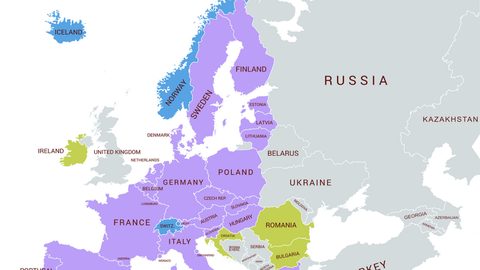 Temporary Schengen Border Checks and What Changes for Rail Trips
A practical guide to Temporary Schengen Border Checks and What Changes for Rail Trips.
-
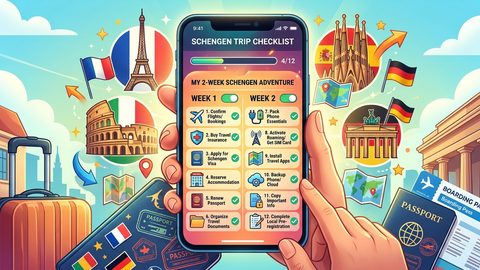 A Two-Week Schengen Phone Checklist for a Four-Country Trip
Plan a two-week, four-country Schengen trip with phone checks for EU roaming, data limits, border switching, offline documents, and emergency calls.
-
 Flight Delays and Schengen Overstay Risk Under the 90-Day Rule
A flight delay on day 89 or 90 inside Schengen can tip you into overstay. Know your rights, your documentation, and exactly what to do.
-
 SIM Cards, eSIMs, and Roaming Costs for Schengen Multi-Country Travel
Non-EU visitors face real connectivity costs across Schengen. Compare home roaming, local SIMs, and regional eSIM plans before you pack.